
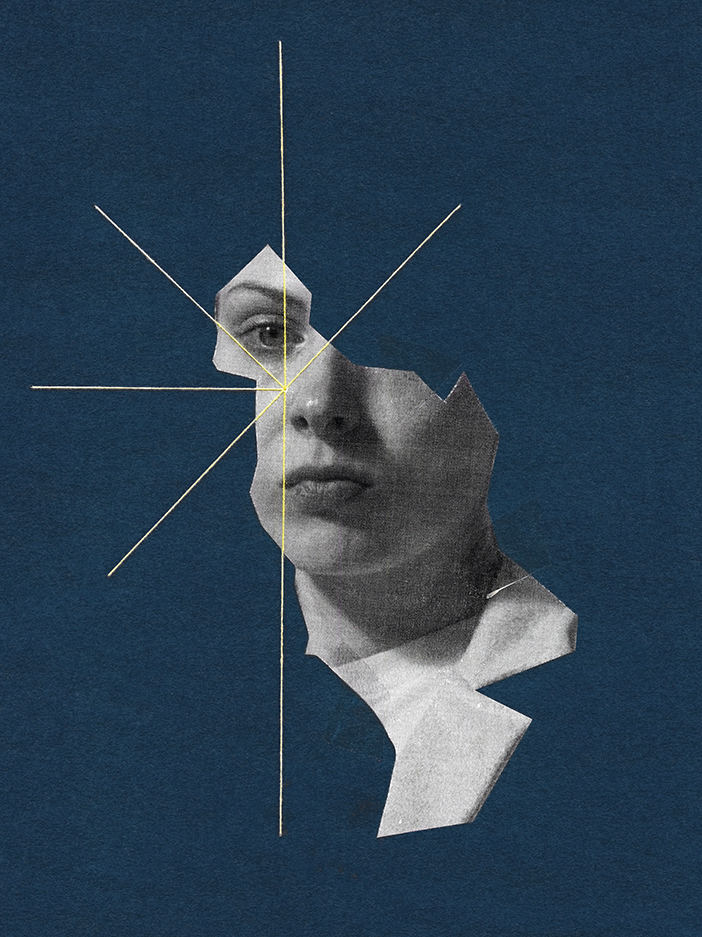
Gwendoline Riley’s novels are not exactly easy to read and they were not, it would seem, easy to write. “I have to get to the point where my only two options are: to do the writing or to kill myself,” Aislinn, one of Riley’s autobiographical-seeming narrators, explains in Opposed Positions (2012): “My aversion is commensurate to my will, so it’s tough. Every word gets to be like a steamer trunk.” Aislinn’s mother begs her to find “any kind of job” to “take you away from endless introspection and obsessing over your childhood”. It’s not a bad description of the novelist’s vocation, a novelist of Riley’s commitment at least (she has just won a Windham-Campbell Prize). In 2007, aged 28, and already on her fourth novel, she described what she does in similar terms: “It really is picking at scabs and lying awake and mulling over things that it would really be much more cheerful not to mull over.”
The wounds Riley has pried open most persistently and productively are those bequeathed by parents. Like her narrators, the parent characters across her fiction have varying names but are broadly continuous. They are in their different ways more like children than parents. The narrator’s father, a tyrannical narcissist from whom her mother fled – though the narrator still had to endure weekend visits – is unrelievedly odious, a write-off. The mother figure, obstinately self-sabotaging, is more pitiful than malicious but looms larger – or longer – as a source of exasperation: the adult narrator keeps up a carefully distant relationship with her, the stage-managing of which is draining to behold. The father is bullishly himself, “like a baby”, “so starving and so greedy”; the mother is mulishly inauthentic: “she acted frightened all the time. And there was a petulance in there.” The father is uninterested in genuine connection, the mother incapable of it. They both demand attention and reject affection. Her father “liked to bark what he saw”, indifferent to response but requiring undivided focus; her mother liked to make “little self-announcements”.
The extraordinary dialogue – hardly the right word for it – in Riley’s novels is distinguished by a stomach-churning absence of fluency, a mutual lack of authentic responsiveness. The pleasurable spontaneity of real conversation is replaced by the dismal effortfulness of keeping up the pretence of one. To “weather” their parents Riley’s narrators develop different ways of strenuously playing dead, a kind of rag-doll choreography. Dodging or absorbing her father’s jousts, not “provoking” him; feeding her mother “prompts” to which “she felt that she had the right answer, an approved answer” so that talking could be like a “game, or a rhyme we were saying together”. What makes the novels desolate is what this lack of naturalness amounts to. “Be natural and let him be natural. That’s what love is,” Neve coaches herself, hoping to defuse the abusive rages of her husband Edwyn in First Love (2017), a queasy gothic horror of domestic life. “I love animals, their natural ways,” she observes. Those may well be the only two mentions of the word in the novel, the title of which is a wicked misnomer.
Amid the loveless parental barrage, life goes underground, becomes “inner life”. The narrators “shut down inside” and then “drift off, inside”. Dissociation is a costly technique, the price extreme isolation. But it’s also a fertile one, the dark soil from which this literature grows. Riley’s novels feel powered by a primordial anger and hurt roiling far below the crisp surface. “Writing is a kind of revenge against circumstance,” the poet Louise Glück once said, and vengeance is the cathartic reward for Riley’s cheerless dredging.

The intensity and authority of her formidably accomplished style come from the rigorous austerity of this project. Every “steamer trunk” she hauls on to the page lands with an almost preternatural sense of necessity. Riley once complained in a book review of the “resistible assertions” the author had allowed herself. Resistible assertions. Not simply: mean what you say, but: only assert that which you cannot resist asserting – what has to be said even if you can hardly bear to say it. Hence the brevity of these riveting, gruelling novels, which you wouldn’t want to be any longer. From that arduous face-off between aversion and willpower emerges the potent terseness of Riley’s prose. You don’t squander words if you are inking them in blood.
This almost masochistically authentic approach means that Riley can do without a method: “I just see what catches fire.” It can be touch and go. She said that her last – and best – novel, My Phantoms (2021), “felt so out of joint until really late on”, when it at last “clicked into place”, became “meaningful”. With Riley’s new novel, her seventh, it feels as though that moment never quite arrived: the flames somehow never took. The Palm House is an unnerving anomaly: a book by Riley written in ordinary ink. It lacks a pressing subject, that unmistakable sense of aboutness. Or perhaps it has too much of a Subject. It opens with the narrator, Laura, in a Southwark pub with her old friend Putnam, who is moaning about having prematurely retired from his beloved literary magazine, Sequence, following the installation of a philistine “company man”, Simon “Shove” Halfpenny, as editor. The novel’s central, or anyway most prolonged, drama – for want of a better word – is essentially shop talk.
If the book’s flatness is out of character, it may be because it is, in a sense, written out of character. Riley once said she couldn’t write in the third person (“it always sounds so false”). The Palm House may be the closest she has come to a third-person perspective, or at least a split perspective, since much of it is about Putnam’s midlife crisis. Riley is a fan of Janet Malcolm and her narrators are not unlike Malcolm-esque interviewers – presenting unimpeachable fronts behind which brew exhilarating betrayals, neutral foils to the self-skewering animation of her interlocutors whom she mercilessly records and analyses. The juicy hostility of this pose is missing from The Palm House; Laura is familiarly passive – a prompter and an observer – but to little obvious purpose. Putnam’s moping is no match for the helpless spectacle of Hen, the narrator’s mother in My Phantoms, and Laura’s bond with him lacks a clear charge – neither love nor hate (nor both).
There is a traumatic childhood memory, a series of encounters with a sinister paedophilic comedian, culminating in sex with the 15-year-old Laura, which he appears to film and which leaves her in pain for days. But this is confined to an interlude, strangely unintegrated with the rest of novel, most of which seems low-stakes in comparison: the Sequence reshuffle; Laura’s nothing-y fling with a buffoonish actor named Lawrence Wells; buying a flat with her inheritance. All of Riley’s novels, though lean, are loose: diaristic and episodic, a collaging of fragments of memory. Yet the pieces cohere, galvanised by that suppressed pain. The Palm House is a mellower book – the “drifting off, inside” more companionable: “We had our own thoughts” – but also a more rudderless one. The parts do not really hang together.
Although Riley doesn’t put a foot wrong, she puts fewer feet right than one has come to expect. The images – too few and far between – feel a little familiar: “He had a cold, smooth voice, like a heavy pair of scissors cutting rich fabric.” Riley has always been too sophisticated and scrupulously precise to succumb to Fine Writing. “The sun was high – a white torch in deep blue – and the tarmac glinted like an ocean,” she writes in Opposed Positions, during a sojourn in America – a rare reprieve from the damp, grey British cities where her novels are mostly set. It’s a glittering sentence, saved from being lyrical (“deep blue”) by the accuracy of “white torch”. Habitually associated with a kind of icy economy, Riley’s style is in fact more of an interestingly mixed bag. Alongside the concision there is qualification and jolty hesitation; she blends ornate archaisms (“Mullions and portico columns ribbed the way”) with boldly naff parochialisms (“I suggested the Nero near Westfield”). She is a devastating recording device but capable of sounding raw, frail, reedy notes.
The prose in First Love borders on poetry: “the cracked old bars of soap… sat banked around the taps. Black in the cracks. Cracked like bark.” This may be too much for some tastes – though note the unfaltering accuracy (Riley never lets words get the better of her). Even in a plainer register, her manipulation of language is shockingly powerful. Her novels are in many ways about the violence of other people’s language, which she exhibits to the reader in the form of ugly specimens: “Get back in the sewer, scum,” Edwyn says to Neve in First Love. That signature use of italics gives us the sense that such words are not simply being recalled, let alone invented, but are seared into her memory, and she sears them into ours in turn. Riley’s language can verge on a violence of its own, though of an almost silent kind. In My Phantoms, Bridget recalls that her “mother had linked arms with me on this stretch; she’d gripped my sleeve and leant in. I hadn’t brushed her off, exactly, but it hadn’t taken, and she didn’t try it now.” It hadn’t taken: that chilling, almost excruciatingly sad euphemism for rebuff. And not “she didn’t try now”, but “she didn’t try it now”: the aggression in that inconspicuous extra syllable. “I remember one afternoon in Tesco, when we were doing his big shop…” she says of her father. His: that unassuming pronoun, freighted with disgust.
The Palm House is low on such lethal virtuosity. “Here I folded up the paper bag my flapjack had come in, and sealed it in my empty coffee cup, and looked around for a bin.” This undistinguished sentence feels like filler, a means of punctuating dialogue. Even the names are underpowered, unconvincing. Simon “Shove” Halfpenny sounds like the name of a character, as does Laura Miller in its bland way – almost implausibly generic. Edwyn, by contrast – the perfectly chosen name of Neve’s appalling husband – still haunts me; that slithering, skin-crawling “y”, poised between realism and a horrifying fairy tale (“Like a snake Edwyn rose from his slumber…” Riley writes at one point).
For all their extreme precision – there is no sentimentality, no melodrama – Riley’s last two books have grotesque dimensions. For all their narrowness they constitute a universal portrait of a type, or type of relationship. Here, she was evidently going for different effects. “These were the murky effects,” in fact, are the first words of the new book; perhaps, then, it is deliberately unclear about what it all adds up to. Maybe one should think of The Palm House as an experimental novel, or a transitional one. Scab-picking is compulsive – and there is a repetitive quality to the novels it yielded, characters blending, similar scenes recurring. Perhaps they should be seen as a multi-volume autobiographical saga, shorter than My Struggle but no less courageously thorough. First Love dealt with the death of the narrator’s father, My Phantoms with the death of the narrator’s mother. It’s the problem with laying ghosts to rest, with scabs healing into scars: one must find a new compulsion. Or perhaps only a new enthusiasm: what you’d like to say, now you’ve said what you had to.
The Palm House
Gwendoline Riley
Picador, 224pp, £16.99
Purchasing a book may earn the NS a commission from Bookshop.org, who support independent bookshops
[Further reading: O Father, where art thou?]
Content from our partners


Related

This article appears in the 08 Apr 2026 issue of the New Statesman, The Fall
Join the debate
Subscribe here to comment